
Denise de Pauw and Natasha Rust show that you don’t need more assessment, more grades, or perfect disciplinary alignment to support international students in STEM — you need structured opportunities for students to talk, reflect, and belong.
The brief
In this blog post, we share our experiences of designing an innovative module for the Faculty of Engineering and Physical Sciences (EPS) at the University of Leeds, to help students with the transition to postgraduate studies.
Perhaps unusual for many UK institutions, our Language Centre was approached by the faculty who had noticed only a low percentage of new international students had completed a presessional course. The faculty felt that these students, who had met the language requirements for their postgraduate taught (PGT) programme, nevertheless needed additional input to mobilise their academic knowledge-base and raise their individual achievement. As English for Academic Purposes (EAP) practitioners, we recognise that presessional courses are really important for helping provide students with a sense of belonging, and there is a body of research that shows this ultimately contributes to academic success (e.g. Ahn and Davis, 2020; Ahn and Davis, 2023) and so we welcomed the opportunity to work with the faculty on a bespoke module. The Language Centre at Leeds has also seen a change in pre-sessional enrolments, where more students are choosing an online course, which to date has been an English for general academic purposes module, and therefore, lacking a more specific discipline focus. Therefore, our target students were those who are new to study in the UK, new to postgraduate study, maybe new to the discipline and who hadn’t done a pre-sessional.
Context
“Professional and Academic Communication for MSc students in the Faculty of EPS” is a portfolio- based pass/fail module, worth 15 supernumerary credits and is available to students in the following eight schools that comprise the faculty:
- School of Electrical and Electronic Engineering
- School of Computing
- School of Civil Engineering
- School of Mathematics
- School of Mechanical Engineering
- School of Chemistry
- School of Physics and Astronomy
- School of Chemical and Process Engineering
Insessional Language Centre teaching is embedded in all of them, either at undergraduate or postgraduate level, or both.
Needs analysis and syllabus design
Students have extremely varied needs across the different disciplines, from health and safety in the Chemistry laboratories to describing and discussing mathematical formulae in Physics and Mathematics . We conducted our needs analysis by talking to academics and EAP colleagues in the schools, conducting literature reviews and collaborating with academics about specific tasks, for examples, for oral interactions.
We decided to focus heavily on oracy as part of academic literacies in our module design, primarily because we think it gives access to both sense of belonging and the hidden curriculum, which again, have been shown to contribute to wider academic success. By oracy, we mean speaking and interacting as part of the process of active construction of knowledge, as well as the more product-focused idea of oral competence, e.g. as could be assessed by a task such as a screencast or presentation and viva.
We developed the following six units:
| Unit | Topic |
|---|---|
| 1 | Introduction to University of Leeds and Schools’ communication and life. |
| 2 | Disciplinary vocabulary and terminology- techniques and strategies |
| 3 | Use of technology in knowledge construction and language learning |
| 4 | Communicating in intercultural contexts. |
| 5 | Preparing to communicate in the laboratory, practical or discursive sessions. |
| 6 | Multimodal Communication |
In each unit, students were introduced to ways of thinking about the topic, then encourages to explore strategies, frameworks, tools or conduct discourse analysis and apply principles that they learn in these units to exemplars in their own contexts.
We chose a blended learning approach to delivery, as we wanted students to have access prior to arrival, bearing in mind our main objective was to aid transition. Blended learning also socialises students into the kind of platforms that are used at the university for leisure and study, and this is another important aspect of transition (Newman, 2023).
For assessment we are using “contract grading” (Bailey and Wilkinson, 2023; Gabor, 2024), where students either attend an in-person session or complete a series of chosen tasks to obtain the 15 supernumerary credits. Contract grading has been shown to both promote fairness and help with transitions to new HE contexts, as it removes the stress of having to achieve a certain grade from a very unequally distributed starting point.
We’ve designed our module around a portfolio which begins with some self-assessment and goal setting, then continues in a reflective learning cycle. Each unit offers a portfolio task, and students need to complete and submit three to pass the module. Only the Unit 6 task is compulsory.
Challenges
We faced several hiccups with the setup, due to the scale and ambition of the pilot:
- getting an even spread of resources from each of the eight schools
- issues with the supernumerary status which was affecting optional module enrolment
- getting the communication and marketing correct for the students
We also had to consider how to avoid duplicating our pre-sessional curriculum or our insessional teaching, recognising that we also needed to utilise both of these. We saw the module as a bridge between the two, to connect the way that we taught in the pre sessional, but also how we follow up with our embedded insessional teaching.
Other challenges included having to reiterate the rationale, aims and structure of the module to a steady stream of students from the launch date of September 1st to the middle of the semester. We provided the information in various modes, but nevertheless students still needed clarification or reassurance. We also found students seemed to want more in-person activities, whereas we designed the module to be more asynchronous and online, for equal access, as we knew there would be late arrivals and it would be hard to schedule to avoid some students missing out.
Evaluation
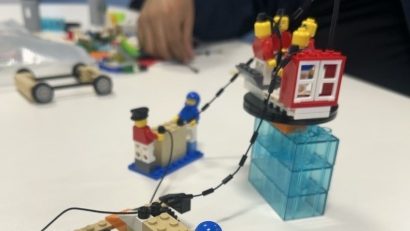
We offered several in-person sessions in International Orientation Week and Welcome Week. Students attending these enjoyed practical hands-on tasks that involved oral communication in a low-stakes informal setting but with a clear pedagogical focus. For example, we used Lego Series Play to explore intercultural communication, and we received enthusiastic feedback from students within the session itself and also in a feedback questionnaire.
Reflecting on the module design, the learning through play approach was really successful in the live sessions. However, both we and the students felt we could have included slightly more challenge or rigour for those in-person sessions. In particular, we could have added time to reflect on the learning objectives, and how on task students were. We do think gamification is an important pedagogy and we want to combine this with more community building in our online content.
On a slight tangent, students in the online discussions have frequently raised linguistic diversity as an interest and are concerned with it as a resource and a right, often making concrete suggestions of how this can be enacted on campus. Insights such as this can give us, educators, new ways to promote inclusion and sense of belonging on campus and online.
Next steps
We have recently met with the faculty head, who is pleased with the pilot and would like us to develop it further next academic year. We’re also joining a larger Language Centre Impact Study on insessional work and have been granted ethical approval for a study to gather evidence of whether the module has impact on student outcomes, their grades and their sense of belonging.
We’ll collect different data to measure impact. We’re going to look at semester one average module marks for those that took the module, their final project marks, their portfolio data (engagement and extracts), the module evaluation survey and hopefully hold a focus group for perception data. Finally, we’ll look at the opt-out statistics, as initially every eligible student was auto-enrolled.
The faculty wanted a year-long module so alongside developing the module for next year based on this first pilot iteration and the impact study, we’re also busy considering what more we can offer in the semester 2 and the summer period, still pitched within oracy. We’re excited for what the next stages will bring, and hope to share updates in due course!
Denise de Pauw, d.b.depauw@leeds.ac.uk, and Natasha Rust, n.rust@leeds.ac.uk, are both Senior Lecturers in English for Academic Purposes at the University of Leeds Language Centre. Natasha Rust is also a committee member of the STEM SIG.
References
Ahn, M.Y. and Davis, H.H. 2023. Are local students disadvantaged? Understanding institutional, local and national sense of belonging in higher education. British Educational Research Journal. 49(1), pp.19–34.
Ahn, M.Y. and Davis, H.H. 2020. Four domains of students’ sense of belonging to university. Studies in Higher Education. 45(3), pp.622–634.
Bailey, A. and Wilkinson, C. 2023. Ungrading the composition classroom: Affect, Metacognition and Qualitative Learning. Journal of Basic Writing. 42(2), pp.6–34.
Gabor, C. 2024. Just One More Thing? Pedagogy. 24(3), pp.427–440.
Newman, T. 2023. International students’ digital experience [Online]. Bristol: JISC. [Accessed 13 February 2025]. Available from: https://www.jisc.ac.uk/reports/international-students-digital-experience-phase-two-experiences-and-expectations.
💡 5 ideas you could try next term
- Build regular low-stakes speaking into your classes.
- Use pass/fail or completion-based tasks to reduce anxiety.
- Design tasks that students adapt to their own discipline.
- Create space for talk before, during, and after core teaching.
- Use simple, playful activities to build confidence and belonging.
💬 Join the conversation
Which of the five ideas feels most realistic in your context? Please leave a reply below.
Leave a Reply